


Running a successful business is not only about having a great product or service. Behind every sustainable company is a solid financial foundation. This is where Corporate Finance plays a critical role. For entrepreneurs and business owners, understanding how money flows through a company helps in making smarter decisions, managing risks, and planning long-term growth.
In this guide, we simplify complex ideas for practical use, covering how financial planning works and the concepts every entrepreneur should understand to build a financially healthy business.
What Is Corporate Finance?
Corporate Finance focuses on how businesses raise capital, allocate resources, manage financial risks, and maximize company value. It includes financial planning, investment evaluation, funding choices, and cash flow oversight.
In simple terms, it helps business owners answer questions like:
a. How should we fund growth?
b. Where should capital be invested?
c. How can debt be managed responsibly?
d. How do financial decisions affect profitability and valuation?
These principles apply equally to startups and established organizations.
Why Financial Planning Matters for Entrepreneurs?
Many entrepreneurs rely on intuition when making financial decisions. While instinct is valuable, decisions supported by structured financial understanding led to more predictable outcomes.
A clear grasp of corporate finance for entrepreneurs helps:
a. Prevent cash flow shortages
b. Reduce unnecessary borrowing
c. Improve financial forecasting
d. Support informed expansion decisions
c. Build confidence among investors and lenders
Without disciplined planning, even profitable businesses can struggle to sustain operations.
Core Financial Foundations Every Business Owner Should Know
Before going deeper, it’s important to understand the corporate finance basics that support sound decision-making.
1. Cash Flow Management
Cash flow is the lifeblood of any business. Consistent inflows ensure salaries, suppliers, and operating costs are covered without stress.
Key takeaway:
Profit does not always equal cash. Managing inflows and outflows is a core part of the fundamentals of corporate finance.
2. Capital Structure
Capital structure refers to how a business finances its operations, usually through:
a. Equity (owner capital or investors)
b. Debt (loans or credit facilities)
Finding the right balance is essential. Too much debt increases financial risk, while excessive equity may dilute ownership. This balance is one of the most important corporate finance concepts for long-term stability.
3. Cost of Capital
Every funding source has a cost. Understanding this cost helps determine whether an expansion or investment is financially justified. Ignoring it often leads to expensive financing that reduces overall profitability.
Key Elements That Influence Business Performance
Let’s explore the key elements of Corporate Finance that directly affect business outcomes.
1. Investment Decisions
Investment decisions focus on where company funds are allocated, such as:
a. Purchasing equipment
b. Expanding operations
c. Launching new products
d. Acquiring another business
Well-evaluated investments focus on long-term value rather than short-term gains.
2. Financing Decisions
Financing decisions involve choosing the right funding method at the right stage of growth. Options may include loans, working capital facilities, equity funding, or internal reserves.
Entrepreneurs who understand corporate finance for business owners are better positioned to select options aligned with sustainable growth.
For expert guidance, working with experienced advisors can simplify these decisions. Learn more about SME and advisory solutions here!
3. Risk Management
Risk is unavoidable, but it can be managed. Financial planning helps identify risks such as:
a. Interest rate changes
b. Currency exposure
c. Liquidity challenges
d. Credit risk
Proactive risk management protects businesses during economic uncertainty.
Applying Financial Strategy in Real-World Scenarios
Many assume financial strategy applies only to large corporations. In reality, it is equally relevant for small and mid-sized businesses.
This is corporate finance explained in everyday terms:
a. Deciding whether to lease or buy equipment
b. Evaluating loan offers
c. Planning seasonal cash flow
d. Assessing expansion into new markets
These principles help entrepreneurs shift from reactive decisions to strategic planning.
Entrepreneurs vs Large Corporations
While the principles remain the same, application differs.
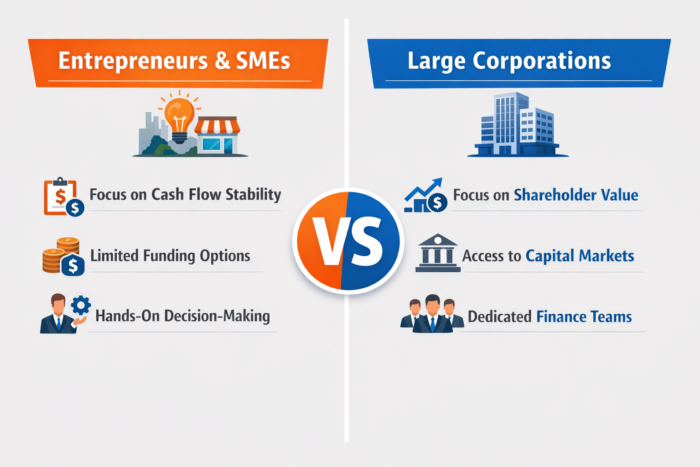
This difference makes financial planning more practical and decision-focused for smaller businesses.
Common Financial Mistakes to Avoid
Many challenges stem from poor planning rather than low revenue. Common mistakes include:
a. Overuse of debt
b. Weak cash flow forecasting
c. Poor capital allocation
d. Inconsistent financial reporting
Avoiding these issues requires discipline and ongoing financial monitoring.
How Financial Planning Supports Business Growth?
A strong financial strategy supports:
a. Sustainable scaling
b. Smarter hiring
c. Expansion readiness
d. Improved profitability
e. Higher business valuation
Businesses with structured financial planning are more attractive to lenders, investors, and strategic partners.
If you’re planning growth or restructuring, expert guidance can make a measurable difference. Explore how we support businesses at TheTrustedPartners.
Best Practices for Stronger Financial Decision-Making
To strengthen financial discipline:
a. Maintain accurate financial records
b. Review cash flow regularly
c. Align financing with growth stages
d. Seek professional advice when needed
e. Use data-driven forecasting
These practices reinforce financial stability across the organization.
Final Thoughts
Understanding Corporate Finance is no longer optional for entrepreneurs aiming to build resilient and scalable businesses. From managing cash flow to evaluating investments, the right financial knowledge supports confident decision-making.
Whether you’re launching a startup or growing an established business, mastering these principles puts you in control of your financial future.
If you’re looking for tailored guidance, explore our financial advisory services and take the next step toward sustainable growth. Contact Us!